Ragtime, or piano-rag was a very expressive genre of music and focused heavily on individuality. When this genre of music was first introduced, it was mainly populated by African-Americans. As ragtime began to spread throughout the nation, the audience became more diverse too. Although the audience of this music was changing, it was still mainly enforced by African-Americans. There is a rumor that ragtime got its name from the rags or pieces of cloth that the slaves wore when they were working in the fields.
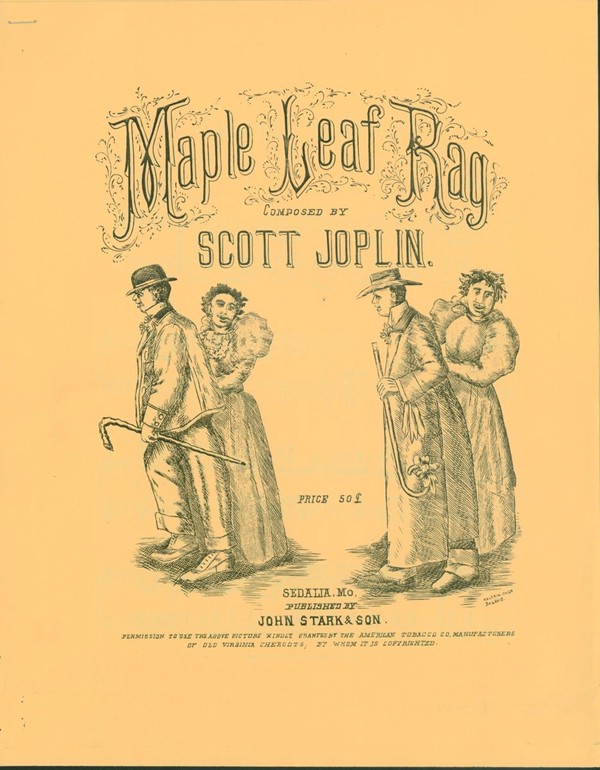
Ragtime was first introduced in the late 19th century and spread very rapidly during the early 20th century. One of the primary contributors to ragtime music was Scott Joplin. He was from Texarkana and learned to play piano and guitar at a very young age. Both of his parents were musical, his dad playing the violin and his mom playing the banjo and singing. During Joplin’s era, African-American pianists were not permitted to play in concert halls or places where white people gathered. Black musicians were most commonly found in churches, brothels, and red-light district bars. Scott Joplin changed this by playing in the Maple Leaf Club in Sedalia, Missouri. This sparked the idea of black musicians getting noticed by white people as serious musicians, rather than their precedents.
Many of the white people were not happy that ragtime was becoming socially acceptable in their establishments. They thought that “rag” music and the dancing that accompanied it were highly inappropriate. Keep in mind that during this time period most of the population went to church every week. They considered it evil and feared that it would sweep the nation and corrupt the young people. One person said, “It is an evil music that has crept into the homes and hearts of our American people regardless of race, and must be wiped out as other bad and dangerous epidemics have been eliminated.”
As you can see from above, ragtime was a very controversial and influential genre of music due to the fact that it promoted individuality and expressed new musical techniques that had not been traditional. When I say traditional, I am referring to the European style of piano playing. Ragtime differed from this style because it contained a syncopated beat, this is when you stress a beat that is generally weak. The ragtime player’s right hand would play the melody and their left hand would mash the keys to give it the ragged sound. Hiram Moderwell, a distinguished ragtime player, wrote “It has carried the complexities of the rhythmic subdivision of the measure to a point never before reached in the history of music. It has established subtle conflicting rhythms to a degree never before attempted in any popular music or folk-music. It has shown a definite and natural evolution--always a proof of vitality in a musical idea. It has proved its adaptability to the expression of many distinct moods.”


music9618ragtime-morath-KRMA.jpg
Works Cited
Blue, Rose. "Chapter 7: From Ragtime and the Blues to Jazz." History of Gospel Music. By Corinne J. Naden. N.p.: n.p., n.d. N. pag. Print.
Chase, Gilbert. "Chapter 23: The Rise of Ragtime." America's Music, from the Pilgrims to the Present. 3rd ed. New York: McGraw-Hill, 1955. 413-27. Print.
Schmidt-Jones, Catherine. "Connexions." Connexions. N.p., 07 July 2011. Web. 13 Dec. 2013. <http://cnx.org/content/m10879/latest/>.
Schmidt-Jones, Catherine. "Connexions." Connexions. N.p., 15 Feb. 2013. Web. 09 Dec. 2013. <http://cnx.org/content/m10878/latest/>.


No comments:
Post a Comment